
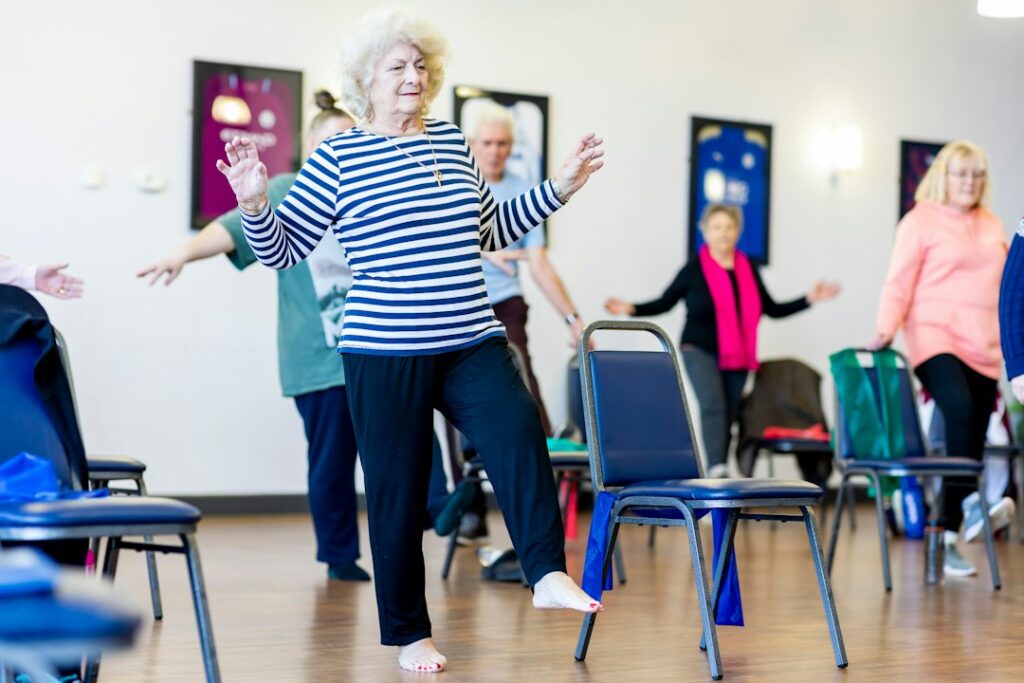
What should a fitness program in assisted living include?
A well-designed fitness program for older adults should support strength, balance, flexibility, endurance, and confidence with everyday movement. It should also be adaptable for residents who use walkers, wheelchairs, canes, oxygen, or other mobility supports.
Fitness in assisted living does not need to resemble a traditional gym workout. Activities may include seated exercises, guided walking, stretching, light resistance work, balance practice, or movement incorporated into daily routines.
The goal is not athletic performance. The goal is helping residents maintain abilities that support daily life, such as standing from a chair, walking to meals, reaching into a cabinet, getting dressed, or moving safely between rooms.
What types of exercise are appropriate for older adults?
Most senior fitness programs combine several types of activity rather than focusing on only one.
- Aerobic activity: Walking, seated marching, gentle dancing, or repeated arm movements can support heart and lung function.
- Strength training: Resistance bands, light hand weights, or body-weight exercises can help maintain muscle strength.
- Balance exercises: Supported standing, weight shifting, heel-to-toe movements, and controlled stepping may improve stability.
- Flexibility exercises: Gentle stretches can help maintain comfortable movement in the shoulders, hips, legs, and back.
- Functional movement: Practicing sit-to-stand transfers, reaching, turning, and safe walking can connect exercise to daily tasks.
Residents do not have to complete every activity at the same intensity. A person with arthritis may need slower, smaller movements. Someone recovering from an illness may begin with a few minutes of seated activity. A resident with stronger mobility may be ready for longer walks or more challenging balance exercises.
How can exercise help residents maintain independence?
Regular movement can help preserve the strength and coordination needed for everyday tasks. Stronger leg muscles may make it easier to rise from a chair. Better balance can support safer walking. Improved flexibility may help with dressing, bathing, and reaching.
Physical activity can also help reduce the effects of long periods of sitting. Assisted living routines sometimes involve extended time in a room, dining area, or common space. Short movement sessions throughout the day can be useful even when a resident cannot participate in a longer class.
Fitness programs may also support social connection. Group exercise gives residents a regular opportunity to talk, encourage one another, and maintain a sense of routine. For some people, the social benefit is as valuable as the physical activity.
Are seated exercises effective?
Yes. Seated exercise can be useful for residents with limited balance, fatigue, joint pain, or difficulty standing for long periods. It may include:
- Seated marching
- Ankle pumps and heel raises
- Arm circles
- Gentle torso turns
- Reaching in different directions
- Squeezing a soft ball
- Light resistance-band movements
Seated activity is not automatically easy. Repeated movements can raise the heart rate and challenge the muscles, particularly when performed with control. However, chairs should be stable, positioned on a level surface, and used in a way that does not encourage residents to lean or slide.
Seated exercise should be viewed as one option, not a lesser form of fitness. It can help residents participate safely while building tolerance for additional movement.
How often should seniors exercise?
Federal guidance generally encourages older adults to work toward a weekly combination of aerobic activity, muscle strengthening, and balance exercises. However, these goals should be adjusted to a person’s health, ability, and current activity level.
A resident who is inactive does not need to begin with a full workout schedule. A practical starting point may be:
- Five to ten minutes of gentle movement once or twice a day
- Strength exercises on two nonconsecutive days
- Brief balance practice while holding a secure support
- Stretching after the body is warm
- Short walking periods spread throughout the day
Progress should be gradual. Increasing the duration, number of repetitions, or resistance too quickly can lead to soreness, fatigue, or injury. Rest days and lighter activity days are a normal part of a safe routine.
What safety precautions matter most?
Safety begins with matching the activity to the resident’s abilities and health conditions. A fitness routine may need adjustment for heart or lung disease, diabetes, osteoporosis, arthritis, Parkinson’s disease, recent surgery, or a history of falls.
Residents should report unusual chest pressure, severe shortness of breath, faintness, sudden weakness, or sharp pain during exercise. These symptoms require stopping the activity and following the facility’s medical safety procedures.
Other useful precautions include:
- Wearing secure, comfortable shoes
- Removing clutter from walking areas
- Using prescribed mobility aids correctly
- Drinking enough fluid when medically appropriate
- Allowing time for warm-up and cool-down
- Avoiding rapid changes in position if dizziness is a concern
- Exercising in a comfortably ventilated room
- Using supervision or support for higher-risk activities

A health condition does not always mean exercise must stop. It often means the activity needs to be modified. Medical guidance may be necessary when symptoms are new, worsening, or difficult to predict.
How can seasonal weather affect fitness in Lansford, PA?
Seasonal conditions can influence how residents stay active. Cold weather, snow, ice, and wet walkways may make outdoor walking unsafe at times. During those periods, indoor hallways, common rooms, and designated activity spaces may provide safer alternatives when properly supervised.
Warmer months may allow outdoor movement, but heat, humidity, glare, and uneven ground still require attention. Residents may benefit from shorter sessions, shaded areas, comfortable clothing, and access to water when appropriate.
Indoor programs should not depend on outdoor access. A well-planned routine can continue throughout the year with seated exercises, hallway walking, stretching, music-based movement, and supervised strength activities.
What should families ask about an assisted living fitness program?
Families and residents can ask practical questions before participating:
- Are activities adapted for different mobility levels?
- Is seated exercise available?
- Are balance and fall-prevention exercises included?
- How are walkers, wheelchairs, and oxygen equipment accommodated?
- What happens if a resident becomes tired or dizzy?
- Are sessions offered at different times of day?
- Can activities be adjusted after illness, hospitalization, or a fall?
- How are residents encouraged without being pressured?
A strong program respects personal choice. Participation should be encouraged, but residents should not be embarrassed or pushed beyond their abilities.
What if a resident dislikes exercise?
The word “exercise” can feel discouraging to someone who has never enjoyed formal workouts. Movement may be more appealing when connected to familiar activities, music, conversation, gardening tasks, walking to visit a friend, or practicing a specific daily skill.
Short sessions are often easier to accept than a long class. A resident may be willing to participate in five minutes of movement after breakfast or before an afternoon activity. Preferences also matter. Some residents enjoy group classes, while others prefer quiet individual practice.
The most useful program is one that residents can perform consistently and safely. Fitness should support comfort, confidence, and daily function rather than create pressure to meet an unrealistic standard.
